
Crop Report - May 25, 2026
May 25, 2026
Crop Report
Crop conditions and weather
It was an interesting transition from winter to spring this past few months, with Mother Nature seeming to not quite commit to either season: melt-snow-melt-snow, hot-cold-hot-cold. But what a welcomed change to see standing water in the fields and sloughs full compared to the lack of snowmelt and dry conditions at the start of spring last year. Even without a seed in the ground, there is already a lot more potential for a good growing season going into this year.
May has brought a roller coaster of weather with some extreme temperature swings, from mid-20’s down to below freezing within days, and now into the 30’s a mere week after seeing snow. About 1.25 to 1.5” of rain/snow fell on the May long weekend but after the hot, windy week ahead of us, we’ll be looking for another shot of rain once the crops emerge.
What's going on in the field
Seeding got off to a slow start but has been in full force, even with the rain/snow delay over the May long weekend. Some of the earliest seeded crops have started to emerge and with the unseasonably hot weather this week coupled with good soil moisture, the later seeded crops will be popping out of the ground within a week of seeding.
Both of our fertilizer trials (one on Mistawasis and one on Muskeg Lake Cree Nation) were successfully seeded! This year will be the third and final year of these trials, and we thank the farmers who dedicate their time and commitment to this research during the extremely busy spring seeding period on the farm.
The cool, windy weather during mid-May has made pre-seed spraying (“spring burn-off”) a challenge. Not only have fewer weeds emerged because of the slower growing conditions during the cool weather, but when temperatures dip down into the low single digits or freezing at night, plants tend to ‘shut down’ and the activity of the herbicide is affected (i.e. they do not work very well). Spraying can resume the following day but generally not until the temperature is above 8-10C for at least a few hours, and if it’s not too windy by this time of day so the herbicide does not drift onto areas and neighbouring fields where it isn’t wanted. If the herbicide is not able to be applied before seeding, then the next window is “pre-emergence” timing - when the herbicide is applied after seeding but before the crop has emerged from the soil. This pre-emergence window can be tricky to time since crop emergence is dependent on the environmental conditions - under cool, dry conditions, you can have a week or more to spray before the crop emerges, but with the warm, moist soil conditions we’re currently experiencing, crop emergence can be as few as 3 days (many herbicide labels specify that a pre-emergence application take place within 48 hours after seeding). If the crop is beginning to poke out of the ground, the farmer will have to either change herbicides (although the options become limited depending on the crop being grown), or the spring burn-off will have to be abandoned and the herbicide plan for the in-crop application will likely have to be changed. Some years it can be a real race for the sprayer to stay ahead of both the seeder and the newly emerging crop!
Farmer’s Focus: Insights for the Weeks Ahead
As seeding wraps up at the end of May/beginning of June, farmers will be hopefully able to take a small breather before in-crop herbicide applications begin, although this could be one of those years where seeding barely finishes and it’s already time to jump on the sprayer. As the canola emerges, early season insects such as flea beetles and cutworms will need to be monitored. Canola is most susceptible to flea beetle damage during the cotyledon to 2-leaf stage, when the plants are young and have the smallest amount of leaf area. All canola seed is purchased with an insecticide and fungicide treatment on the seed which protects the young seedlings from early season insect feeding and diseases (seed and root rots). In the case of flea beetles, the beetle must take a bite of the plant in order to ingest the insecticide which causes the insect to die. However, high flea beetle populations means many bites out of the canola plants are taken, and these young seedlings simply do not have the leaf material to withstand that level of defoliation. In these situations, a foliar insecticide may have to be applied in order to reduce the number of flea beetles before they kill too many of the canola seedlings. Generally, once the canola plants have 2 or 3 good leaves on them and conditions are favourable for crop growth, they can withstand the pressure from flea beetle feeding.
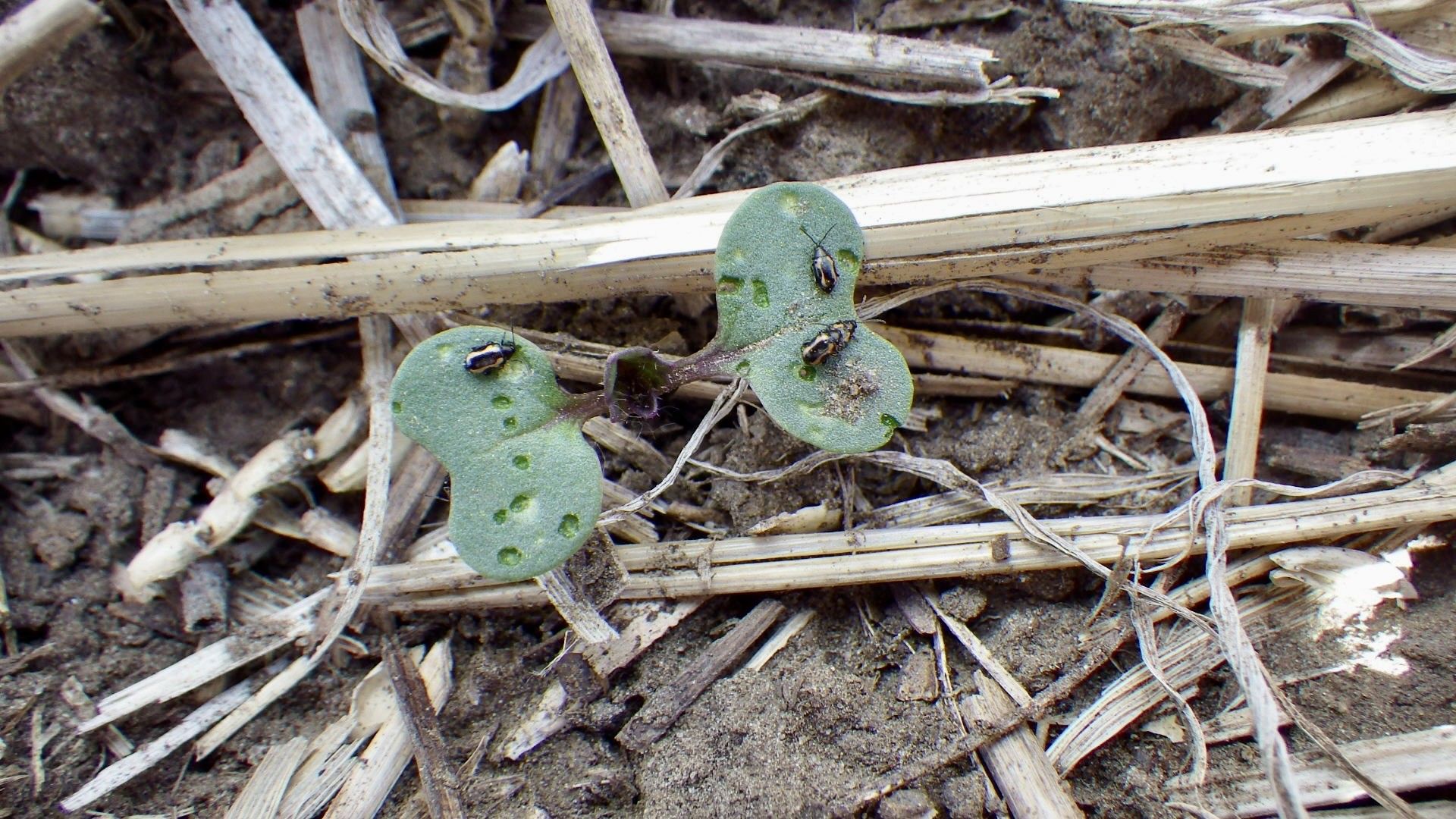
Striped flea beetles feeding on the cotyledons of a canola seedling. Flea beetles make characteristic “shot-hole” feeding damage to the leaves.
While flea beetles are only a pest of canola (and other brassicas such as cabbage, kale, radishes, and turnips), cutworms can also feed on young cereal (wheat, barley, oats) and pulse (pea, lentil) plants. Cutworms are found under the soil surface resting during the day and feed during the evening and night (some cutworm species emerge from the soil to feed aboveground at night while others remain below ground to feed). Signs of cutworm damage include cut-off plants and bare patches in the field where the plants have been chewed off.
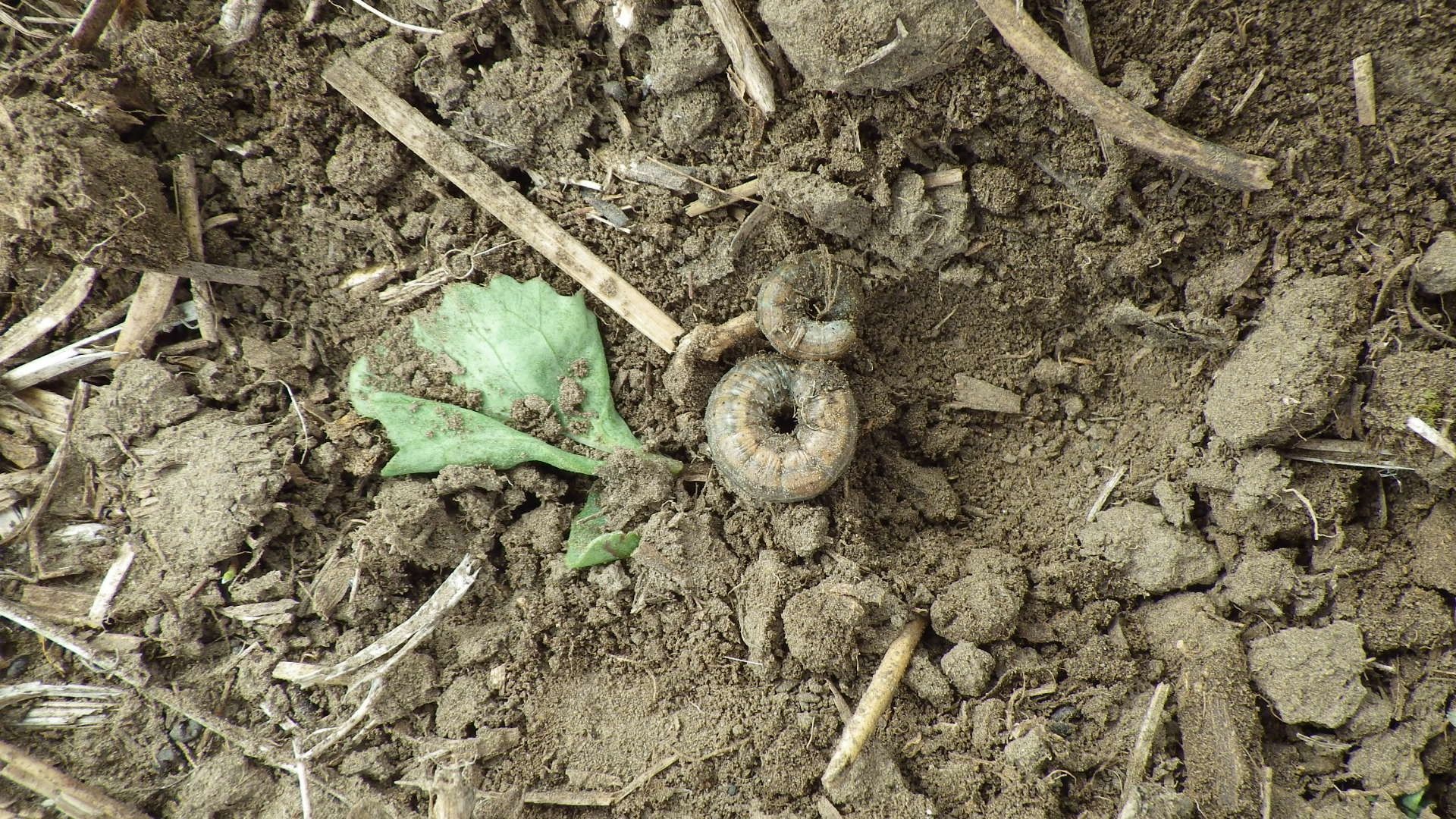
Cutworms cut off their host plants at or below the soil surface. Here, one of the two red-backed cutworms has severed a canola plant, leaving
only a wilted leaf behind. Cutworms curl up into a “C” shape when disturbed.
Author
Jennifer Bogdan
Agronomist
Bridge to Land Water Sky Living Lab