Building Resilience with Eco-Buffers

February 23, 2026


Eco-buffer shelterbelts are the modern successors of prairie windbreaks that were first widely planted in the mid-twentieth century to reduce the effects of the dustbowl era on cropland. For over a century, rows of trees across the wide-open landscapes of the Canadian Prairies have protected farmyards, crops, livestock, and soil from harsh prairie winds. Today, eco-buffer shelterbelts have evolved to be a more diverse, resilient, and ecologically conscious approach to land stewardship in the prairies.

Traditional shelterbelts typically consist of one or two tree species planted in straight rows to act as windbreaks. They are effective at providing critical ecosystem services in Saskatchewan’s dry, windy climate, including reducing wind speed, preventing soil erosion, trapping snow, and conserving moisture.


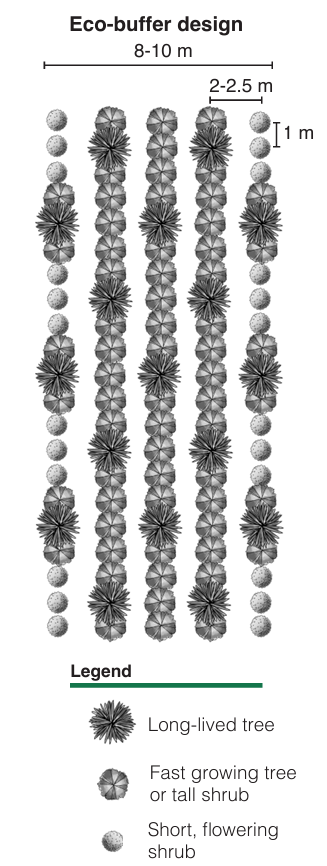
Eco-buffers take the role of traditional shelterbelts a step further; designed to mimic natural forest ecosystems, eco-buffer shelterbelts incorporate multiple native tree, shrub, and forb species planted in denser, more natural arrangements. Instead of uniform rows, eco-buffers grow to create layered vegetation of varying heights, growth rates, and life spans. This results in a more complex micro-ecosystem that provides the benefits of a traditional shelterbelt while providing a wider range of ecosystem services.


One of the most significant advantages of eco-buffers is their value to native biodiversity. By incorporating native plant species with staggered bloom periods, eco-buffers provide continuous food sources and habitat for pollinators including bees, butterflies, birds, and bats throughout the growing season. Improved pollinator habitat benefits the natural ecosystem as well as adjacent cropland. In agricultural settings, this biodiversity boost can translate into natural pest control and improved pollination for nearby crops.
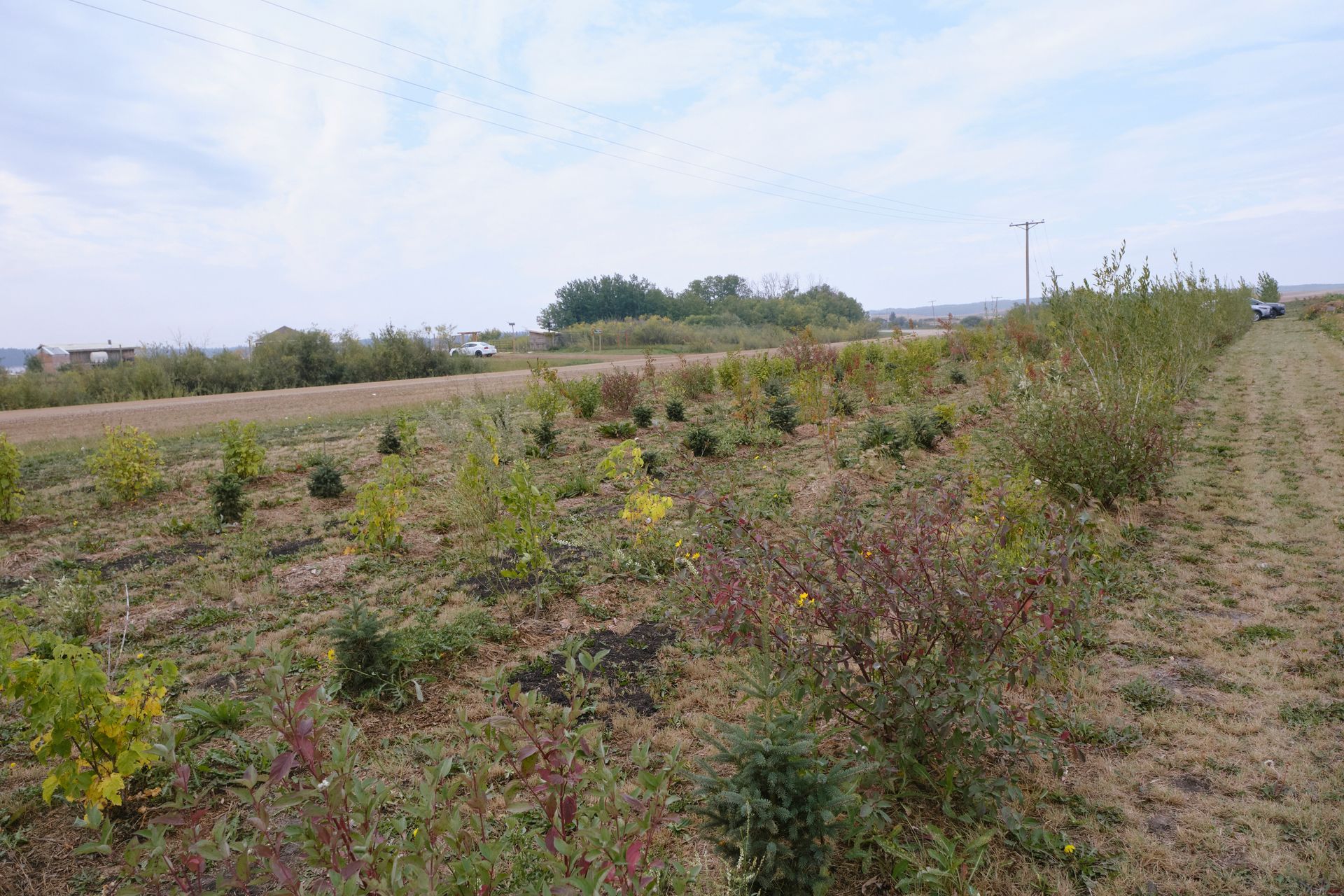
These diverse plantings also create habitat corridors that connect fragmented landscapes. Birds and beneficial insects nest in shrubs and trees, and mammals use the buffers for cover while roaming the landscape. When networks of eco-buffers are connected to create larger wildlife corridors, there is often a corresponding reduction in the incidences of wildlife-vehicle collisions.

Eco-buffer shelterbelts are particularly powerful when established along riparian areas adjacent to rivers, streams, and wetlands. Below ground, dense root systems improve nutrient filtration and stabilize streambanks, which reduces erosion and sedimentation. Increased below-ground biomass further supports complex communities of microfauna and insects that decompose organic matter and agricultural runoff and convert them to plant-available forms of nutrients. Plants uptake those nutrients for growth, filtering elements that would otherwise remain in the water system and could potentially cause significant damage to aquatic ecosystems, like excess nitrogen and phosphorus.

Above ground, dense eco-buffers act as a physical barrier to slow wind and water runoff during heavy rain events or spring melt, which allows water to seep into the soil and replenish groundwater reserves. Fast-flowing surface water tends to pick up nutrients and sediment and deposit it elsewhere, as well as carve channels into the soil surface without properly infiltrating belowground. Slower aboveground flow reduces those soil erosion processes, leaving topsoil that is moist and nutrient rich. In the winter, aboveground biomass traps snow, which becomes crucial groundwater after spring melt. The result is cleaner water, healthier soils, and improved resilience to both floods and drought.

Climate extremes are the norm in the Canadian Prairies; frigid winters, hot summers, cycles of droughts and floods, and strong winds are the norm in the Canadian prairies. Native species are key to the success of eco-buffers as they are adapted to these extreme weather and climate cycles and require less long-term maintenance. When properly planned and planted, accounting for soil type, moisture availability, light exposure, and climate, eco-buffers can become largely self-sustaining systems

Common native prairie species used in eco-buffers include Manitoba maple, white spruce, green ash, balsam poplar, trembling aspen, and plains cottonwood. Shrubs such as red osier dogwood, snowberry, and chokecherry add structural diversity and provide food for wildlife. Fast-growing species help establish the buffer quickly and increase early carbon sequestration, while long-lived species ensure durability and resilience over time.


As climate extremes and variability increase across the Prairies, eco-buffers offer a practical adaptation tool for landowners. They conserve soil moisture, reduce evaporation, capture carbon, mitigate flooding, and protect livestock from wind chill and heat stress. In winter, taller species block cold winds and trap snow; in summer, shade reduces energy use around homes and farmyards.

Eco-buffer shelterbelts represent an approach to ecological stewardship that recognizes that soil health, water quality, biodiversity, and farm productivity are closely interconnected. Blending traditional prairie windbreaks with current ecological design principles, eco-buffers provide a solution to current landscape concerns and security for the future of the land.


For more information about eco-buffer shelterbelts, the Government of Canada (https://publications.gc.ca/collections/collection_2017/aac-aafc/A125-28-2017-eng.pdf) and the Alberta Agroforestry and Woodlot Extension Society (www.awes-ab.ca/wp-content/uploads/2018/05/Eco-Buffer-Factsheet-Complete.pdf) have some great resources.


Author

Lydia Sauder

Environmental Technician 

Kinnikinnick Consulting